
Del Toro's Frankenstein Review

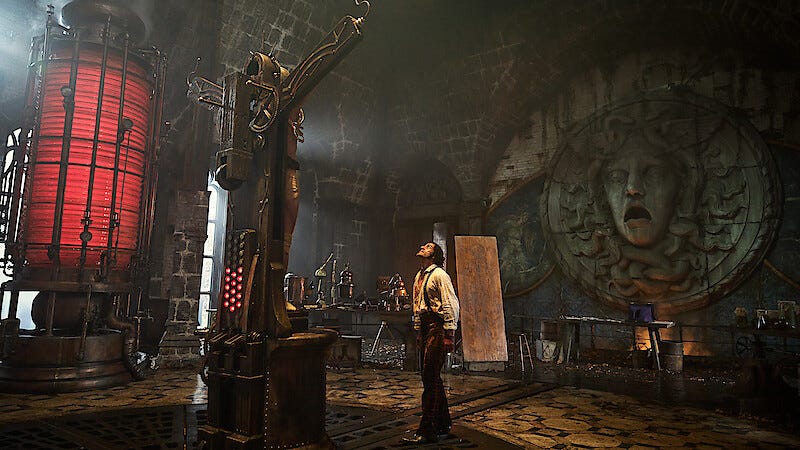
When Mary Shelley was just eighteen years old she began writing Frankenstein; or The Modern Prometheus, for it to be published in 1818 two years later. If you haven’t read the classic literary triumph then you’re likely to know the story, or elements of the story, and there is a good chance you’ve seen a variation of the famous monster from the 1931 film, with his bolted neck and greenish hue.
If you’re unfamiliar, Shelley’s classic novel tells the story of Victor Frankenstein, a man obsessed with mastering resurrection after the death of his mother. Building his own makeshift man and bringing him to life, Frankenstein is horrified by his own creation and rejects him, leading to a violent and tragic story of prejudice and regret.
The latest Frankenstein film adaptation comes from my favourite film director, Guillermo Del Toro, and there was little chance I wasn’t going to enjoy at least some elements of his take on one of my favourite stories.
One of the best things about Mary Shelley’s work in Frankenstein is that there are many big themes from which to explore and Del Toro, being a self-confessed fan of Shelley and the story, clearly takes artistic licence to cherry-pick the themes that excite him most.
The story that Del Toro chooses to share is a painful but hopeful one about father/son relationships, the creator and their creation, the ways in which they can each fuel each others joy but so often aid in their mutual misery.
Del Toro splits the film into two stories, that of Dr. Frankenstein (Oscar Isaac) and then The Creature (Jacob Elordi). A voice-over from each narrator plays over each story until we reach a shared ending with both protagonists.
One could argue that the narration gives in to spoon feeding the audience, there is little room for subtext, but perhaps instead it works as its own love letter to the source material. I think my critical cynicism takes a backseat in this instance due to my adoration of Del Toro and his own love for the story, and I suppose I am willing to allow for the simplicity of such a narrative tool when everything else is such a pleasure to consume.
Even with the more grotesque or gnarly imagery, there is still a rich beauty to Del Toro's work; the frozen horse and soldier, the depictions of human corpses and the reanimation of various body parts, the rotting and abandoned tower.
This is Del Toro's auteur style and vision, that which makes everything about gothic horror so delicious and decaying. It’s this combination that comes across as a love letter to his fans and a reflection of his own heartfelt affair with cinema. Nothing in a Del Toro film is done by accident and so each frame is filled with extraordinary detail.
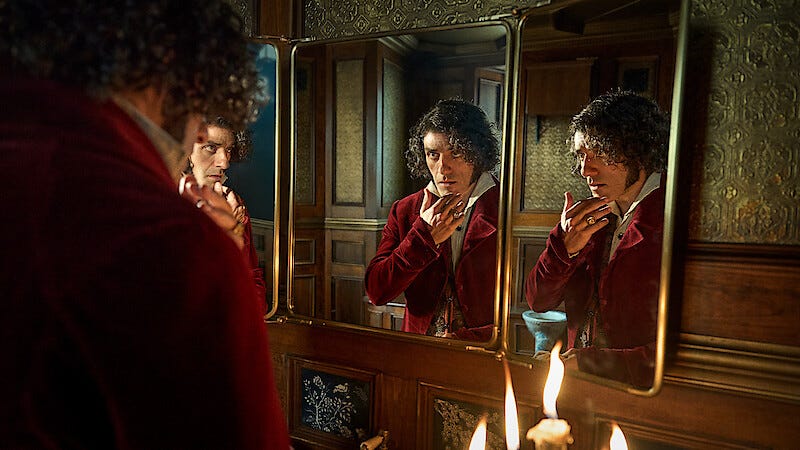
I loved Oscar Isaac’s hammy portrayal of Frankenstein, the ultimate narcissistic who’s genius is dampened by his need for power and those ever looming mummy issues. Forever drinking milk like a juvenile, wearing a reminder of his mother's bloody death in the form of red gloves or scarves, the want to create the way that women are able to— he is mildly insufferable and yet enigmatic enough to, at first, get us on his side.
Whether you are familiar with the story or not, the idea that playing at being a God never produces lucrative results and is rarely done by those with selfless intentions, and yet we watch with a desire to see Frankenstein succeed and create his own monstrosity.
Succeed, he does! However, Victor quickly finds himself horrified by his own creation, and, thinking completely rationally, burns the tower down with the poor Creature still locked inside.
Frankenstein's Creature finds himself escaping from the fire into the arms of water, another rebirth, a baptism with the hopes of washing away the trauma inflicted by his creator, and yet life’s unfairness finds him again and again.
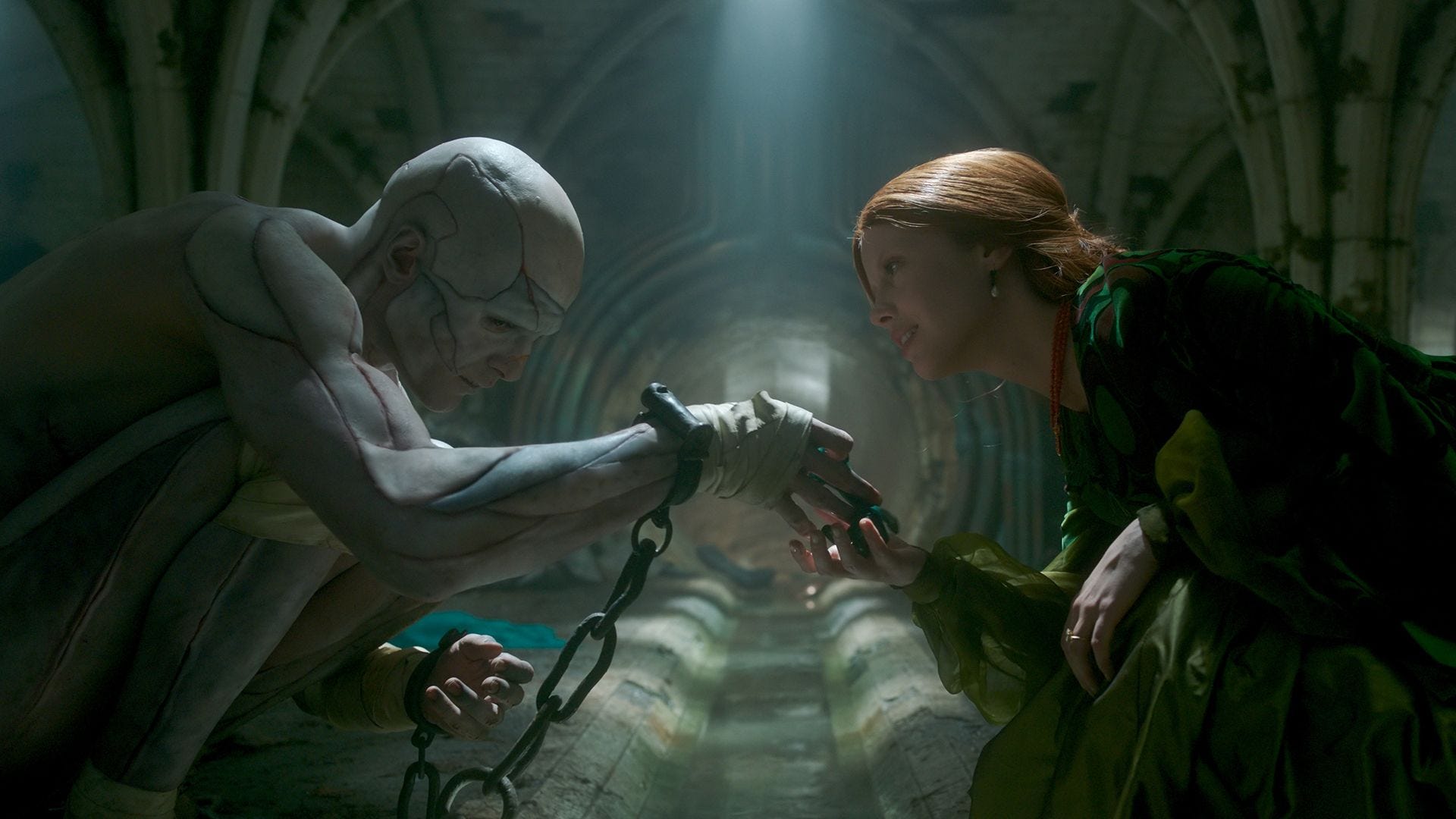
The Creature sheds his toddler-esque clumsiness and begins to learn the ways of human nature, and I liked Elordi's depiction of innocence in The Creature's physical movements, his gentle nature juxtaposing his brute strength.
Elordi does not simply amble around from one point to another, every movement, hand placement and cock of the head is building the character, connoting his progress in personality and intelligence, but also foreshadowing the painful reminder that The Creature's strength will be his ultimate burden.
Del Toro’s expansion on Elizabeth’s (Mia Goth) character works as another tool to encourage empathy towards The Creature. Elizabeth’s kindness towards The Creature, and his own warmth towards Elizabeth, aids Del Toro’s vision of a more humanised version of The Creature; a son mistreated by his father, rather than the more classic reflection on how those that look different are ostracised without reason.
Mia Goth makes a delightful Elizabeth and costume designer Kate Hawley puts her in tones of jewelled opulence, while still reflecting her own, slightly strange nature; her love for little beasts and colourful insects. For Victor, she is just another woman he simply cannot have, a reflection of his selfishness that he does not wish to face.

While there are some pretty hefty themes that Del Toro decides to only momentarily touch upon in favour for more personal and hopeful topics, such is his prerogative as director, and while the very ending of Del Toro's Frankenstein differs from its source material, I really appreciated the more hopeful end for The Creature.
He is able to finally experience the freedom and weightlessness that comes from forgiveness, and there is the suggestion that happiness, or at least peacefulness, could exist for him out there beyond the ice, which matches the tone of Del Toro’s entire vision — and that’s good enough for me.